
The NSE Nifty, comprising 50 shares, breached the 8,300-mark for the first time to hit a new lifetime high of 8,330.75.

BSE benchmark Sensex nursed losses on Friday as investors pocketed gains after a five-session winning streak amid a bearish trend overseas. A depreciating rupee and foreign fund outflows further soured risk sentiment, traders said. The 30-share gauge, which had started the trade on a firm note, soon gave up all the gains and finally ended 651.85 points or 1.08 per cent lower at 59,646.15. The broader NSE Nifty snapped its eight-day rally to close at 17,758.45, down 198.05 points or 1.10 per cent.

Strong performance of past IPOs spurred investors' interest, with 87 small and medium enterprises (SMEs) garnering Rs 1,460 crore through initial share-sales in the first nine months of the year. This was way higher than 56 companies that had raised Rs 783 crore through initial public offering (IPO) in the entire 2021, the industry data showed. Further, the remaining part of the year 2022 can see more mature companies accessing the platform.

Hike in planned public-sector capital expenditure will be credit-positive for infra cos

Sesnsex ended the day flat on heavy selling pressure.

After a turnaround in performance by Indian equity markets since July that has seen the S&P BSE Sensex and the Nifty50 wipe out the year-to-date losses, analysts suggest investors start nibbling into stocks that are focused on the domestic economy. While they say intermittent corrections, led by policies of global central banks and other economic data, cannot be ruled out, analysts expect India's relative outperformance among global equity markets to continue as it looks better placed with a healthy economic recovery, and remains one of the fastest growing major economies. In this backdrop, Neeraj Chadawar, head of quantitative equity strategy at Axis Securities, believes that amid global slowdown, aggressive tightening by the central banks, and preference for domestic interests first (by the local government), export-oriented themes are likely to be muted or will deliver conservative returns in the near-term.

Global trends, trading activity of foreign investors, outcome of state elections and RBI's interest rate decision are the major factors that will drive the movement in the domestic equity markets this week, analysts said. "Global markets are currently in a fabulous mood. The US 10-year bond yield and the dollar index are also cooling off, which gives strength to the market. These factors will be closely monitored, as they have the potential to influence market sentiment," said Pravesh Gour, senior technical analyst, Swastika Investmart Ltd. On the political front, the results of assembly elections in five states are eagerly anticipated, Gour said.

The 30-share Sensex ended up 292 points at 29,571 and the 50-share Nifty closed up 75 points at 8,910.

The Sensex had bounced back with gains of 94 points or 0.3%

Bharti Airtel, HDFC, ONGC, ITC and CIL emerged as the top gainers.

However, experts caution that investors should not expect the big returns they got from the sector between March and September 2020.

Infrastructure, power, capital goods, PSU, healthcare, banking, oil and gas and metal stocks nosedived

The "asset-right" strategy, reiterated by ITC chairman Sanjiv Puri during the company's 112th annual general meeting (AGM) on August 11, received a thumbs up from the analysts. They, however, believe that sustained earnings growth and synergies with the demerged hotel's vertical will help the stock break out from the ongoing consolidation. "The stock is expected to consolidate between Rs 420 and Rs 450 in the near future.
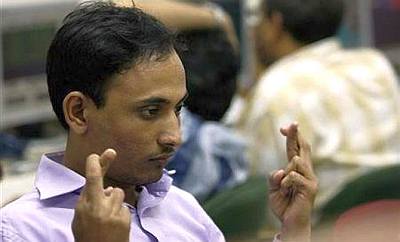
Markets closed the day in green on favourable domestic factors,
In the current calendar year, small and medium enterprises (SMEs) have witnessed an impressive surge in initial public offerings (IPOs), surpassing the 2018 record. Over 150 SME IPOs have been introduced to the market, breaking the previous record of 141 set in 2018. According to data from PRIME Database, a primary market tracking firm, 147 companies successfully concluded their debut share sales by the end of October, raising a cumulative Rs 3,727 crore.

>It's not easy to predict the market. But there are at least two positive factors to back the PSU banks, explains Tamal Bandyopadhyay.

Investor sentiment got a boost following remarks from the Russian President Putin that allayed fears of an imminent military conflict in Ukraine

Market benchmark Sensex tumbled over 323 points after an intense last-hour sell-off on Wednesday, triggered by losses mainly in index heavyweights Infosys, Reliance and HDFC.

Investors are increasingly turning optimistic about shares of new-age companies. From broad-based 'sell' calls, analysts are giving thumbs up to Zomato, Paytm, and FSN e-Commerce Ventures-owned Nykaa as these companies have shifted focus to sustainable profits. The shares of Zomato hit a fresh 52-week high of Rs 126 apiece on the BSE on November 7, having rallied 15.4 per cent in one week.

Among Sensex shares, Bajaj Finserv fell the most by 4.08 per cent. Bajaj Finance declined by 3.01 per cent, Tata Steel by 2.2 per cent, Wipro by 2.09 per cent, Tata Motors by 1.96 per cent, IndusInd Bank by 1.9 per cent, SBI by 1.75 per cent, Tech Mahindra by 1.66 per cent and HCL Tech by 1.2 per cent. TCS, Infosys, Power Grid, Maruti, Reliance, HDFC twins, L&T, M&M, NTPC and Ultratech Cement were also among the losers.
The Sensex and Nifty spiralled lower for the fourth session on the trot on Wednesday as investors remained on edge ahead of US inflation data, which will give clues on the Federal Reserve's policy tightening trajectory. Unabated selling by foreign institutional investors and a jump in crude prices also weighed on sentiment, traders said. Despite a firm start, the 30-share BSE Sensex failed to carry forward the momentum and ended at 54,088.39, lower by 276.46 points or 0.51 per cent. During the day, it tumbled 845.55 points to 53,519.30.

rediffGURU Ramalingam Kalirajan answers your personal finance queries.

Nifty could fall to 9,500 levels; not a good time to bottom fish, say experts

'Unless India Inc's earnings offer promise in March 2017 quarter, sentiment may not reverse in a hurry.'

10 non-bank and non-finance stocks from the BSE500 Index universe that offer an optimal blend of low valuation, reasonably robust revenue and earnings growth in recent quarters, a strong balance sheet, and most importantly, positive cash flow from their operations.

Broader market underperformed the headline indices with BSE Midcap and BSE Smallcap finishing in red

M&M was the top gainer in the Sensex pack, rallying nearly 6 per cent, followed by Bajaj Auto, Titan, Bajaj Finance, HDFC Bank and PowerGrid.

Most NBFCs will have to slow down their loan growth. Some of the most leveraged will have to sell a part of their assets (or loan book) to banks to raise incremental capital. Others may have to knock on the door of their deep-pocketed parents.

As if wanting to be an antidote to the coronavirus pandemic, the Indian stock market adorned carnival robes in 2021 with a tsunami of liquidity unleashed by global central banks coupled with supportive domestic policies and the world's largest vaccination drive sparking off a world-beating rally on Dalal Street, despite bouts of uneasiness over fizzy valuations. While the wider economy shuttled between recovery and relapse, dictated by multiple mutations of the virus, equity market benchmarks appeared headed in just one direction -- skywards. The dizzying upward journey has added a whopping Rs 72 lakh crore during 2021 to investors' wealth, measured as the cumulative value of all listed shares in the country, taking it to nearly Rs 260 lakh crore.

The rupee gained 11 paise to 82.68 against the US dollar in early trade on Tuesday as the American currency retreated from its elevated levels. Forex traders said sustained foreign fund outflows weighed on the local unit and restricted the appreciation bias. At the interbank foreign exchange, the domestic unit opened at 82.69 against the dollar and marginally rose to 82.68, registering a rise of 11 paise over its previous close amid a positive trend in domestic equities.
For the second straight week, the Sensex rose, notching up a significant gain of 528.34 points, or 1.59 per cent. The Nifty was up 129.45 points, or 1.25 per cent, during the week.

TCS was the top gainer in the Sensex pack, rising over 3 per cent, followed by L&T, Bharti AIrtel, HCL Tech, Tata Steel, Bajaj Auto and Reliance Industries. NSE Nifty rallied 164.70 points to its fresh closing peak of 16,529.10.

More than 10% (40 of 498 companies) have lost at least half their market value.

'I want us not to underestimate Indian voters. They can tell good work from bad.'

The rupee breached the 80-mark against the dollar on Tuesday. The steady depreciation in the value of the rupee against the US dollar is likely to prove expensive for corporate India. The listed companies' revenue expenses in foreign currency or imports exceed their export revenues or revenue earnings in forex. In their latest financial year, BSE500 companies, excluding banks and non-banking finance companies and insurance (BFSI), reported combined forex expenses of Rs 12.31 trillion against forex earnings of around Rs 10 trillion.
Stocks of IT, power, healthcare, capital goods, oil & gas, banking and auto were the major drivers.

Market breadth was weak with 1239 losers and 1078 gainers on the BSE.

For the week, the Sensex recorded a fall of 371 points, or 1.10 per cent, and the NSE Nifty 130.75 points, or 1.25 per cent.

These stocks have rallied up to 25% on the BSE in the past month, against the Sensex's 1% gain.
Equity benchmarks erased early gains after realty, capital goods, teck, auto, PSU, IT, power and bankex counters came under selling pressure, falling up to 1.28 per cent.
 © 2026 Rediff.com - Advertise with us - Disclaimer - Privacy Policy - Sitemap - Feedback - About us - Terms of use - Grievances